
How artificial intelligence is transforming digital assets and what executives need to decide when combining both resources
Introduction: Two Technologies That Need Each Other
Artificial intelligence and cryptocurrencies emerged through different paths, but they share one common trait. Both generate more information than a human being can process. A public blockchain records millions of transactions every day, all visible and traceable. Crypto markets operate 24 hours a day, 7 days a week, across hundreds of platforms simultaneously. The conversations that move prices take place on X, Telegram, and Discord at a speed that no human team can keep up with.
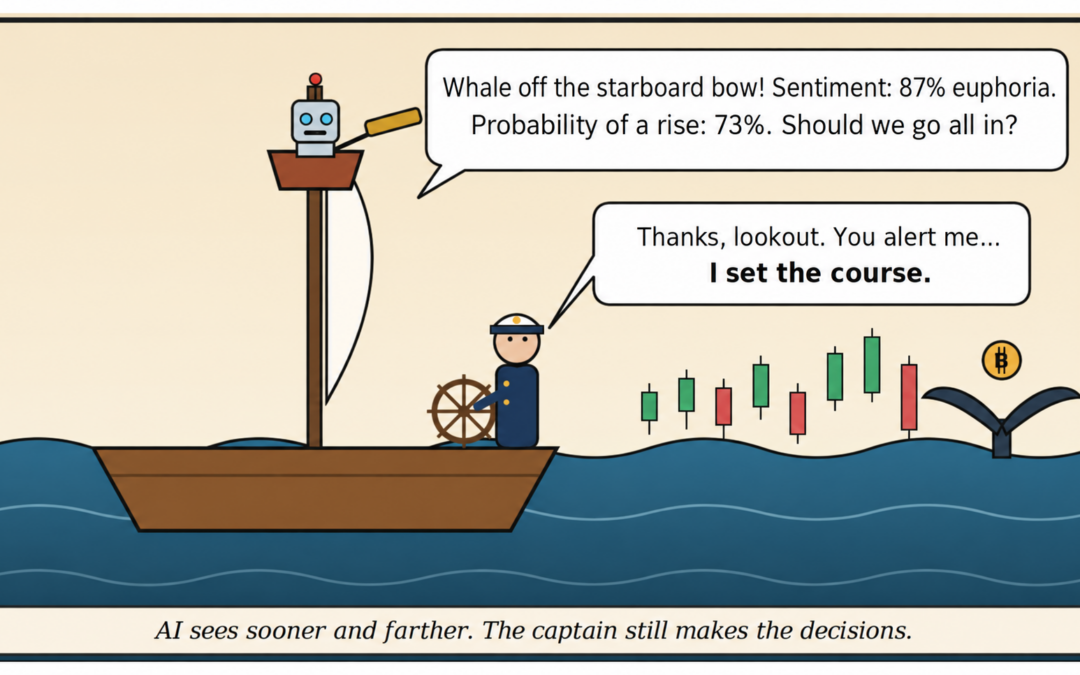
AI appears here as a lookout: the crew member high up in the mast who sees earlier and farther than anyone else. But it is important to remember the central thesis of this article from the outset: the lookout informs; the captain decides. Organizations that confuse these two roles end up paying a high price, and in crypto that price comes quickly.
To structure the analysis, I propose a framework that is easy to remember. Its acronym is precisely V.I.G.I.A.:
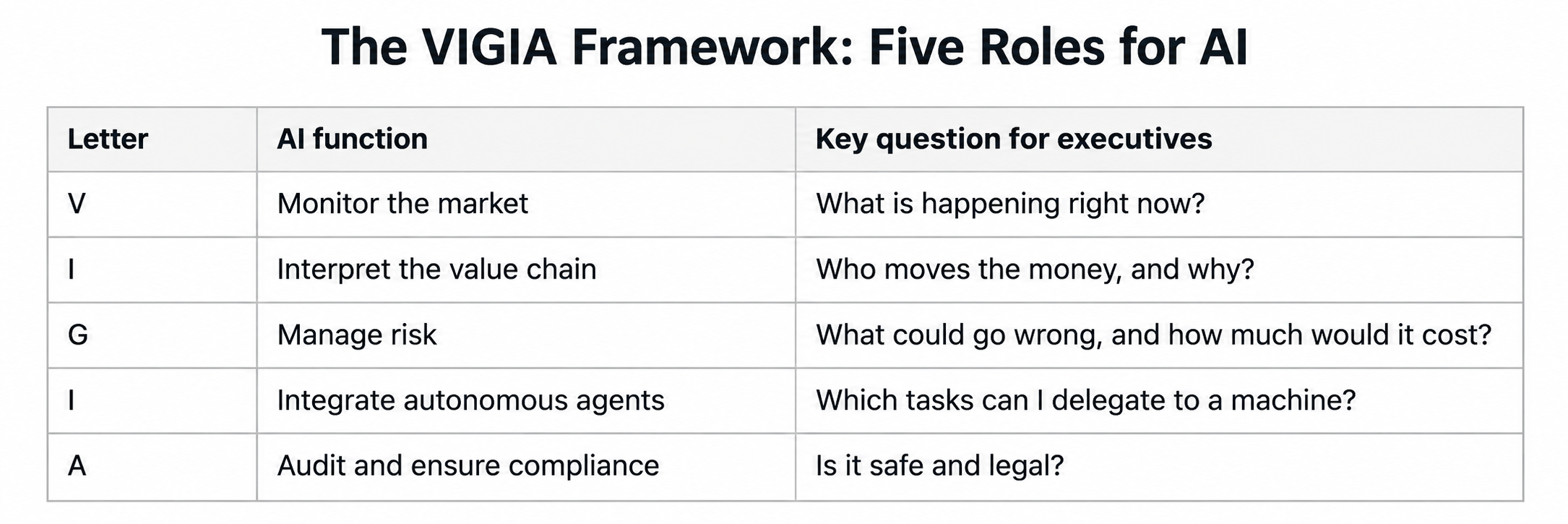
V – Vigilate: Market and Sentiment Analysis
What AI does. Language models and natural language processing systems continuously read news, social media, forums, and project documents. From this information, they estimate market sentiment**: whether fear or euphoria is prevailing, which narratives are gaining traction, and which assets are beginning to be mentioned more frequently.**
Practical example. A fund detects an unusual increase in positive mentions of a mid-cap token. The mentions come from accounts created only a few weeks earlier, and the messages are almost identical. A naïve system would interpret this as “bullish sentiment” and buy. A well-designed system identifies the pattern as a possible coordinated pump and dump campaign and generates an alert in the opposite direction.
Lesson for the executive. Sentiment is data, not an investment thesis. AI is excellent at detecting changes in the conversation. But crypto conversations are full of bots and deliberate manipulation, so a sentiment model without authenticity filters amplifies noise instead of reducing it.
I – Interpret: On-Chain Analytics
What AI does. This is crypto’s most distinctive advantage over traditional finance: the ledgers are public. Platforms such as Chainalysis, Nansen, and Arkham combine this data with machine-learning models to cluster addresses, label wallets — exchanges, funds, market makers**, known hackers — and detect behavioral patterns.**
Concrete examples:
- Whale tracking. When a wallet with a history of successful decisions begins accumulating an asset, the system flags it before the move becomes evident in the price.
- Exchange flows. A massive transfer of coins from cold storage to exchanges often anticipates selling pressure.
- Fraud investigation. Law-enforcement agencies and compliance teams use these tools to trace stolen funds through mixers and cross-chain bridges. Several major hacks have been reconstructed this way, transaction by transaction.
Lesson for the executive. In crypto, transparency is total but unreadable without the right tools. AI turns public data into private intelligence. Whoever masters this layer can see what the rest of the market is missing.
G – Govern: Risk as a Core Discipline
What AI does. This is where AI delivers its greatest value — and also its greatest danger. Its value lies in simulation, anomaly detection, and dynamic parameter adjustment. The danger is a false sense of control.
Institutional example. Firms such as Gauntlet have worked with decentralized lending protocols such as Aave and Compound. Their work involves running thousands of simulations with agents representing borrowers, liquidators, and speculators. The goal is to recommend risk parameters, such as how much can be borrowed against each asset or when a position should be liquidated. This is systemic risk management applied to a financial system that operates by itself, without a central bank or closing hours.
Trader-side example. A trading bot trained on bull-market data may show spectacular backtest results and fail as soon as the market regime changes. This is classic overfitting**: the model has memorized the past rather than learning a robust strategy. In crypto, the phenomenon is amplified because regime changes can be abrupt. A collapse such as Terra/Luna or FTX does not appear in any training dataset… until it happens.**
Three practical rules for AI-driven risk management:
- Hard limits outside the model. Maximum position size, tolerable daily losses, and prohibited assets should be set outside the AI, as “circuit breakers” that the algorithm cannot modify.
- Testing under hostile conditions. Every system should be tested against extreme scenarios: 50% drops within hours, exchanges suspending withdrawals, and stablecoins losing their peg.
- Human oversight with real authority. Someone must be able to stop the system — and must be willing to do so.
Lesson for the executive. AI reduces the risks you already know and can increase the risks you do not know. That is why the decisive question is not “How much does the model make?” but rather “What does the model do when the world stops looking like its data?”
I – Integrate: Autonomous Agents and the Machine-to-Machine Economy
What AI does. This is the newest frontier. An AI agent can already have its own wallet, sign transactions, and pay for services without human intervention. Blockchains offer something the traditional banking system does not give a machine: a programmable account, open 24/7, without the need for a legal identity.
Examples pointing toward the future:
- Infrastructure for agents. Coinbase has developed tools such as AgentKit and the x402 payment protocol. Their purpose is to enable AI agents to pay in stablecoins for digital services, such as a data query or an API call, for fractions of a cent and almost instantly.
- Agents as market participants. In 2024, an AI agent called Truth Terminal became a media phenomenon. After receiving funds from a well-known investor, it became associated with a memecoin that reached a market capitalization of hundreds of millions of dollars. Beyond the speculative anecdote, the case demonstrated something significant: a software agent can influence a real market.
- Tokenized-agent platforms, such as Virtuals Protocol, where agents have their own token and generate revenue.
The other direction of the convergence. Crypto also serves AI. There are decentralized networks for computing and model training, such as Bittensor and Render. There are “proof-of-humanity” systems, such as World, designed to distinguish people from bots on an internet increasingly populated by agents. The relationship is symbiotic: AI needs payments and verification; crypto needs intelligence and automation.
Lesson for the executive. We are still in the experimental phase, with considerable speculative noise. But the direction is clear: future customers will not only be people; they will also be machines buying on behalf of people. It is worth asking today how you sell to an agent.
A – Audit: Security and Regulatory Compliance
What AI does. There are two fronts: code security and regulatory compliance.
Security. Smart contracts are code that holds money and, once deployed, often cannot be corrected. AI-assisted auditing tools review code for known vulnerabilities and anomalous behavior before launch. Afterwards, they monitor systems in real time to detect attacks in progress. The uncomfortable fact is that attackers use the same tools to find vulnerabilities. AI accelerates both sides of the race.
Next-generation fraud. Voice and video deepfakes are already being used to impersonate executives and founders, promote fake investments, or authorize transfers. A basic internal protocol becomes essential: no significant transfer should ever be approved through a single communication channel, no matter how convincing the voice on the other end may sound.
Compliance. In Europe, two regulatory frameworks converge: MiCA, which regulates crypto-assets, and the EU AI Act, which establishes obligations according to the level of risk posed by the system. Both are being implemented progressively. AI helps with compliance through identity verification, money-laundering pattern detection, and monitoring of suspicious transactions. At the same time, it creates new transparency and oversight obligations for the automated systems themselves.
Lesson for the executive. Regulatory compliance is no longer a department; it is an architecture. Designing traceable and explainable systems from the outset costs far less than adapting them afterwards.
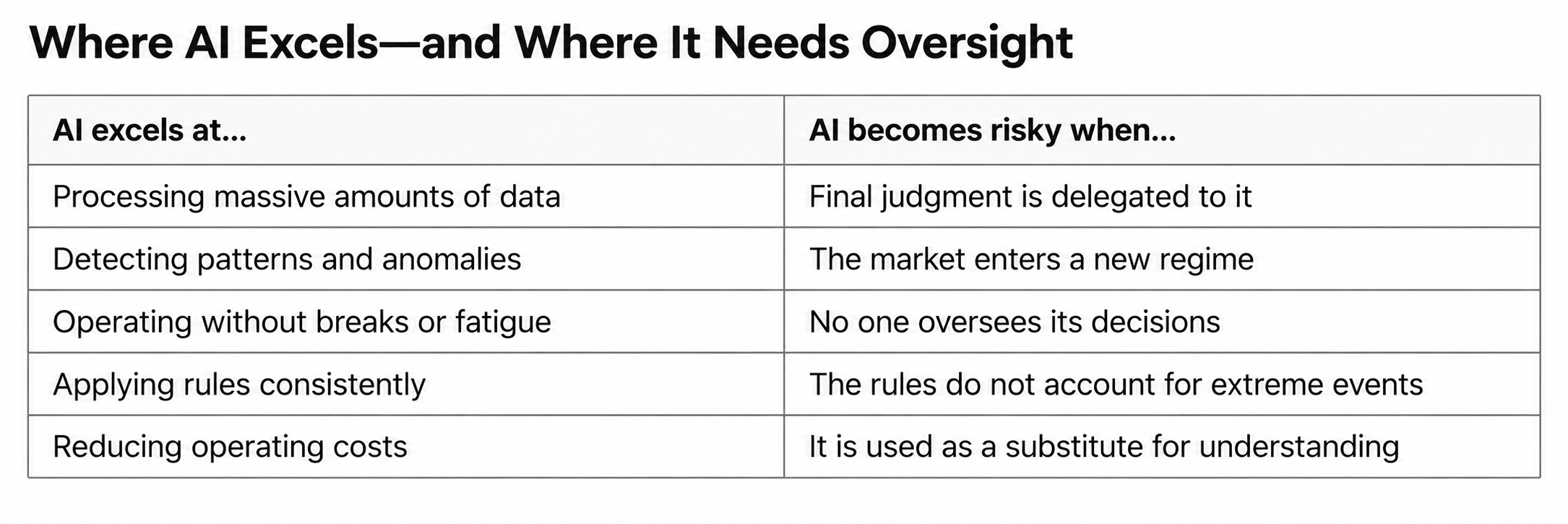
Summary: What AI Does Well — and What It Does Not
The Human Dimension: The Leader’s Role
From an executive-coaching perspective, the most interesting aspect of this convergence is not technological but human. AI automates analysis, but it does not automate three capabilities that remain the leader’s responsibility:
- Defining purpose. A system optimizes whatever it is asked to optimize. Deciding what to optimize — short-term profit, survival, or reputation — is a strategic and ethical decision.
- Tolerating uncertainty. AI generates probabilities, not certainties. An executive who seeks a guarantee from an algorithm is transferring his or her anxiety to a tool that cannot absorb it.
- Knowing how to say no. The most valuable discipline in crypto is not finding opportunities — they are abundant. It is rejecting those that do not fit, even when the model recommends them and the entire market appears to be making money.
Five Questions Before Adding AI to Your Crypto Strategy
For the entrepreneur who wants to move from curiosity to action:
- What specific problem am I solving? Analysis, execution, risk, or compliance? Start with only one.
- Do I understand enough to recognize when the system is wrong? If the answer is no, training must come before delegation.
- Where are the limits that the machine cannot cross? They must be written down, quantified, and kept outside the algorithm’s reach.
- Who can shut the system down, and under what circumstances? If nobody knows, the system is not being supervised.
- Does it comply with MiCA and the EU AI Act? This question must be answered before launch, not afterwards.
Conclusion
Artificial intelligence is already indispensable in the crypto world: it monitors markets that never sleep, interprets blockchain data that cannot be read at a glance, simulates risk, executes with discipline, and protects against increasingly sophisticated attacks. But its value depends entirely on the quality of the human judgment directing it.
Remember the acronym: V.I.G.I.A. AI is the best lookout a financial navigator has ever had. It sees earlier, sees farther, and never gets tired. But in waters as changeable as the crypto market, the course is still set by the captain.